Chronicles
" Longitude of the Specola of Naples to the east of Paris: 47° 44' 3"
Baron von Zach... taking an average between several results for the latitude of the palace of the Royal Museum of Naples,... found it to be 47° 41' 2"; from this, applying the appropriate reduction, we obtain 47° 42' 5" for the longitude of the Specola.
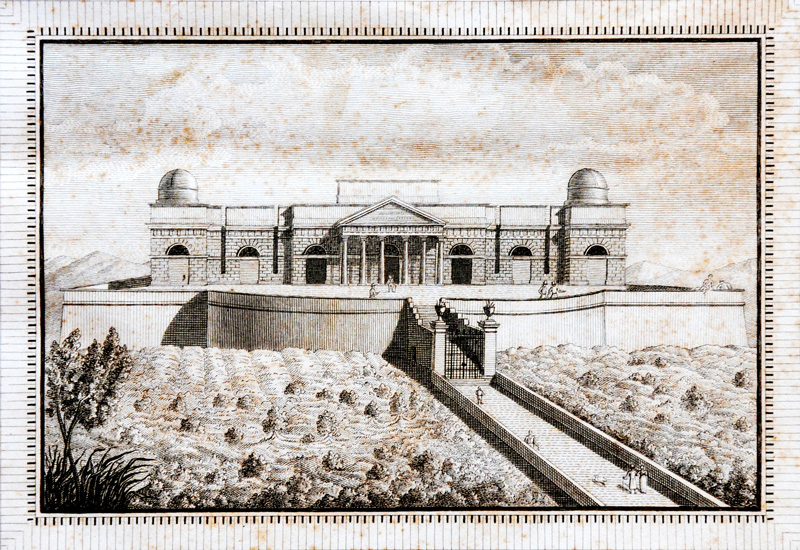
In November 1819, construction of the Royal Specola of Naples on the Miradois hill was completed. The director,
Carlo Brioschi, was finally able to transfer the crates of astronomical instrumentation from the San Gaudioso Observatory and conduct the first test observations.
The San Gaudioso site was subsequently repurposed as the astronomical-nautical observatory for the Naval Academy: It served for the instruction of naval officers, and it was used to preserve and regulate the instruments of both warships and merchant vessels. Its direction was entrusted to Giuseppe Pilati, a student of Father Piazzi and professor of astronomy at the college of marine guards in Naples.
Meanwhile, in Pizzofalcone, the Topographic Office of the Kingdom of Naples had been established by a decree of Joseph Bonaparte on 8 June 1808. Its direction was entrusted to the veteran Paduan geographer Giovanni Antonio Rizzi-Zannoni, who had been working on the drafting of the "Geographic Atlas of the Kingdom" since 1781. He maintained a cabinet of instruments and machines for all his internal and field operations, alongside an observatory staffed by a professor of astronomy and geodesy.
These three public observatories, along with the ancient and now abolished observatory at the University Palace and the private specola at the Palace of H.R.H. Prince Leopold, the former Acton palace, served as the primary reference sites in the city for latitude measurements.
At Capodimonte, Carlo Brioschi and the astronomers Ernesto Capocci and Antonio Nobile carried out the facility's first measurements of the stars and the Sun between 17 December 1819 and 31 December 1820.
In 1819 and 1820, their initial targets included:
Polaris - δ UMa - α Cas - 12 CVn - Spica
Throughout 1820, observations expanded to a wider catalogue of celestial bodies:
Polaris - χ Dra - γ Cas - δ Cas - δ UMi - Spica - ε UMi - β Dra - α Lyr - α Aql - δ Dra - α Cyg - β Cas - Sirius - ε UMa - α UMa - ζ UMa - η Her - η Oph - ϑ Oph - δ Aur - ο Her - χ Lyr - β Lyr - ζ Sgr - Antares - β UMi - η UMa - Arcturus - α Cep
In 1821, the first systematic meteorological observations began. Beyond astronomical research, the Miradois specola housed a fully equipped weather station, continuing the publication of bulletins on daily measurements of temperature, pressure, air humidity, and wind direction that had originally begun at San Gaudioso. This work included the observations of the important annular solar eclipse that occurred on 7 September 1820, alongside the data deduced from it.
In 1877, a dedicated Meteorological Observatory was built in the northern wing of the astronomers' residence. Shortly after, in 1879, two masonry stations and a wooden pavilion were erected for the new Magnetic Observatory, tasked with determining the variations in the components of the Earth's magnetic field.
Ernesto Capocci, nephew of
Federigo Zuccari, was appointed assistant astronomer in 1819 by
Giuseppe Piazzi and dedicated himself to the observation of comets. He soon acquired international renown, to the point that Baron
von Zach dubbed him
the Encke of Italy.
In 1827, following a proposal by
Friedrich Wilhelm Bessel, the
Berlin Academy of Sciences invited him to participate in the compilation of its landmark celestial map. Capocci and
Leopoldo Del Re in Naples, together with Father
Giovanni Inghirami of the
Ximenian Observatory in Florence, were entrusted with charting
Hora XVIII, where the largest section of the Milky Way crosses that specific region.
Observations began in April 1827. Utilizing the
meridian circle and the
equatorial telescope, Capocci and Del Re measured the positions of roughly 7,900 stars and mapped the relative locations of a few hundred double stars. The precision of the Neapolitan astronomers led
Johann Franz Encke to write:
Among the charts we have received so far, yours appears to provide the most faithful and accurate depiction of the section of the sky it represents.
In 1833, following Brioschi's death, Capocci was appointed Director of the Observatory, a position he held until 1850, when he was dismissed by the crown for having participated alongside his sons in the liberal uprisings of 1848. The office was briefly held by Leopoldo Del Re. Following the fall of the Bourbon Kingdom in 1860, Capocci was fully reinstated and served until his death in 1864.
During the period of Capocci's exile, the temporary interim directorship had passed to Leopoldo Del Re. Capocci spent part of this time traveling to Paris, Brussels, and London on an official delegation with members of the government to study emerging technologies and purchase new instrumentation for the facility. Upon his return to Naples, he hired new staff to expand astronomical research, recruiting Michele Rinonapoli, Annibale de Gasparis, Remigio Del Grosso, and the Danish astronomer Christian Heinrich Friedrich Peters.
During the pre-unification era, the prominent personality of Annibale de Gasparis emerged. Serving as Director from 1864 to 1889, having previously refused to take over from the ousted Capocci in 1850, De Gasparis became the main protagonist of astronomical science at Capodimonte during the late 19th century. The post-unification years were difficult, marked by scarce funds and a progressive obsolescence of the facility's assets. The specola, initially equipped with cutting-edge machinery, found that by the 1850s its instrumentation had become outdated.
Despite these limitations, De Gasparis was deeply engaged in celestial mechanics. In 1849, his research led him to discover Hygiea Borbonica (asteroid 10 Hygiea), the first of nine minor planets he would discover. This feat earned him the praise of the world's most prestigious astronomers, the 1851 Gold Medal of the Royal Astronomical Society, and the title of Knight of the Order of the Red Eagle from Kaiser Frederick William IV of Prussia.
Other research activities at Capodimonte continued along the traditional lines of positional astronomy, fulfilling the practical, civic duties typical of a 19th-century observatory: the measurement and regulation of civil time (providing the exact time to the city) and regular meteorological surveys. This was largely because scientific culture in Naples remained tethered to a legacy of pure mathematical studies. In contrast, other European nations were benefiting from a rich cross-pollination between mathematics, chemistry, and physics, which was giving birth to the Astronomia Nova: astrophysics.
Gradually, and overcoming significant friction, Capodimonte entered the international circuit of modern astronomy, thanks entirely to the brilliant intuitions of a few prominent figures. A prime example was Arminio Nobile, who in 1855 was the very first to hypothesize short-period variations in latitude. This phenomenon was "rediscovered" thirty years later by Karl Friedrich Küstner at the Berlin Observatory, who initially took credit for it. Following this episode, Nobile published a firm essay in 1891 titled On a Claim of Scientific Property. He worked in close collaboration with Faustino Brioschi, Francesco Contarino, and Filippo Angelitti, who collectively shaped astronomical research in Naples at the close of the century.
Between 1893 and 1894, Director Emanuele Fergola conducted a series of simultaneous daily observations with the Columbia College Observatory in New York to determine the exact variation of latitude in Naples. Though his background was purely mathematical, Fergola had turned his focus to astronomy in the 1860s, collaborating with Father Angelo Secchi of the Collegio Romano to measure the difference in longitude between Naples and Rome. This historic campaign marked the very first time a telegraph was used in Italy for synchronic data transmission. Fergola was also responsible for the earliest hypotheses regarding the motion of the Earth's rotational poles.
This traditional approach to astronomical studies persisted in Naples until 1912, when Azeglio Bemporad assumed the directorship. Convinced that the future of astronomy lay in investigating the physical properties of stars, Bemporad fought an uphill battle against Neapolitan academic circles that remained rigidly tied to positional astronomy. On the eve of the First World War, the Neapolitan Specola took its first definitive steps into astrophysics by participating in the compilation of the Astrophotographic Catalogue of Catania.
The onset of the war and the subsequent difficult economic recovery led to a sharp drop in investments, causing a progressive aging of the facilities and an impoverishment of human and technical resources. In 1926, Bemporad was forced to admit that running the Observatory with the equipment at his disposal was a daunting, if not desperate, endeavor, especially given the fierce competition from American and northern European facilities: The Capodimonte Observatory was once one of the premier facilities in Italy, indeed in all of Europe... in the first decade of its foundation, just a century ago. Now, looking at the power of modern telescopes, the Neapolitan Observatory stands as the last of the ten observatories that Italy boasts. He noted that while the observatory still maintains the pride of an extremely favorable location for classical astronomical observations, its instrumental potential remains severely limited.
In 1932, Bemporad stepped down from the directorship to focus exclusively on the Catania catalogue project, and the Julian astronomer Luigi Carnera was called to lead the Naples observatory. A staunch defender of astrometric and positional work, which he considered superior to purely theoretical astronomy and astrophysics, Carnera attempted a total overhaul of the institution, imagining its transformation into a specialized astrometric observatory: Astrometry has not lost its reason for existence in the slightest; as there is currently no observatory in Italy dedicated entirely to it, a renewal of the Neapolitan facility tailored to this branch of research would be of maximum interest to science, without creating duplicates or interfering with sister institutions.
In the master plan drawn up by architect Alberto Sanarica, Carnera envisioned establishing Naples as the only city in Italy to unite the university chairs and cabinets of three deeply related disciplines: astronomy, geodesy, and geophysics, creating a scientific hub that would link the observatory on the Miradois hill with the institutes of terrestrial physics and geodesy. Although the ministry did not grant full approval to the grand plan, Carnera’s efforts successfully resulted in the construction of the specialized pavilions for the Repsold meridian circle and the Bamberg transit instrument.
In 1943, during World War II, the observatory was occupied by Allied commands, which installed a radar base for military air control.
The immediate post-war period was exceedingly difficult, and the scientific focus of the Capodimonte astronomers shifted very little at first. However, in 1952, Attilio Colacevich introduced the first photoelectric photometer to Italian astronomy. A few modest stellar photometry programs were established, initial steps that could have integrated the Naples observatory into the expanding fields of global astrophysical research, yet, that threshold was not fully crossed.
It was only under the directorship of Mario Rigutti, starting in 1969, and subsequently under Massimo Capaccioli, that the Capodimonte Observatory found the necessary impetus to transform the ancient, glorious, and unfortunately heavily damaged observatory into a modern institution. A new generation of astronomers was integrated into cutting-edge research programs backed by major international collaborations. As records note, The beginning of this second phase was incredibly tough and demanding... and, naturally, not everyone reacted positively to the sweeping changes.
By 1970, only four astronomers were active at the facility. Within a few years, dedicated research groups were formed: solar physics, focusing on the Sun's photosphere and chromosphere, and stellar physics, dedicated to binary star systems and pre- and post-main sequence stars. Soon after, research expanded into extragalactic physics, focusing initially on the dynamics of elliptical and lenticular galaxies, and later on the kinematic properties of galaxies.
In close collaboration with the former Naval University Institute (now the University of Naples Parthenope), the laboratory for cosmic physics and planetology was established to study cometary and planetary dust and to develop instrumentation for international space missions.
Concurrently, the technology group specialized in the design and construction of the VST (VLT Survey Telescope), a 2.6-meter telescope installed in the Atacama Desert in Chile at the ESO (European Southern Observatory) site for wide-field deep-sky observations.
Having officially joined the National Institute for Astrophysics (INAF) in 2002, the Capodimonte Astronomical Observatory stands today as one of the most active and prestigious international institutes, contributing across all major frontiers of modern ground-based and space-based astrophysics.